

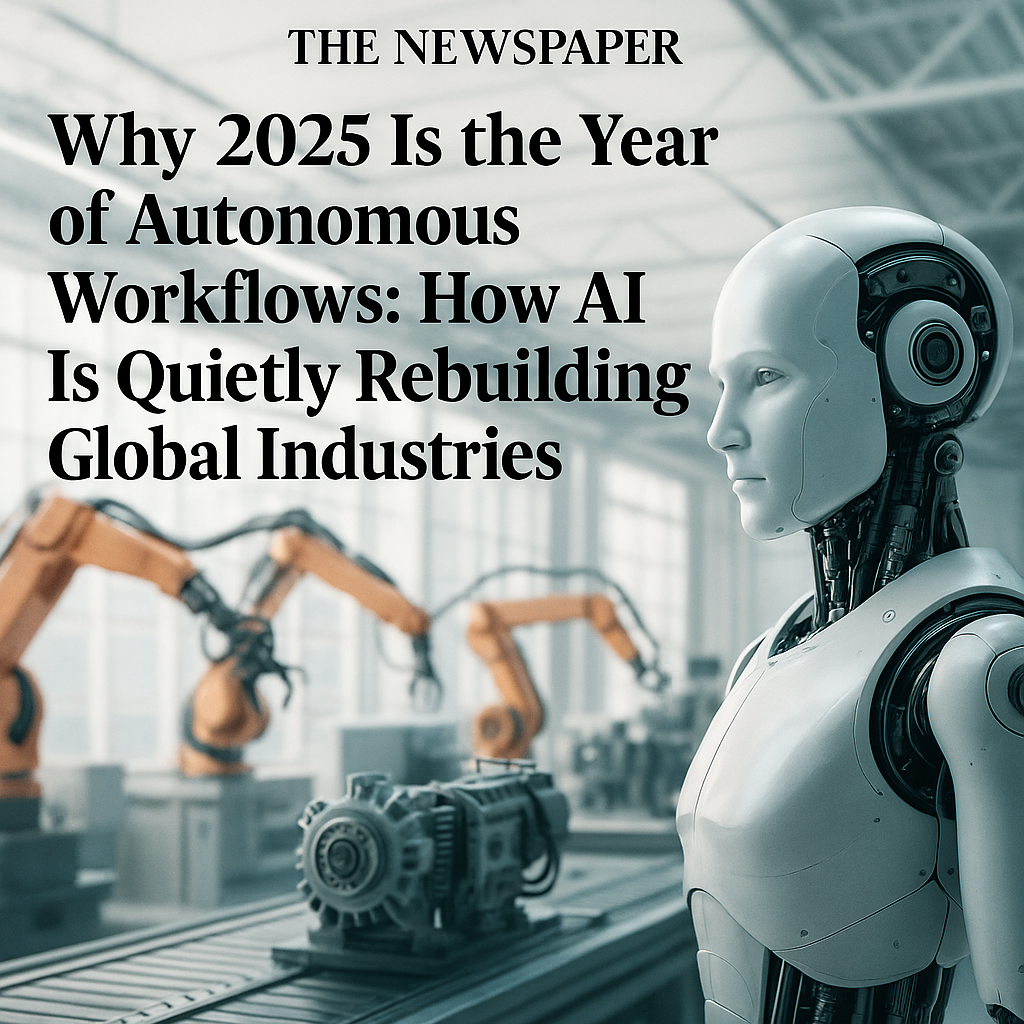
In 2025, businesses around the world are adopting one of the most influential technological shifts of the decade: autonomous workflows. These are systems that complete tasks with little to no human intervention — powered by AI, automation, robotics, and real-time analytics.
From logistics to healthcare, finance to retail, autonomous workflows are increasing efficiency, reducing costs, and eliminating bottlenecks at a scale that was unthinkable just years ago.
This is the new backbone of the global digital economy.
1. Autonomous Logistics Is Becoming the Global Standard
Shipping, warehousing, and delivery networks are seeing rapid transformation:
Automated Systems Include:
- AI route optimization
- autonomous forklifts
- self-driving delivery carts
- drone-based last-mile delivery
- robotic picking systems
- predictive inventory engines
These systems complete tasks 24/7 with minimal human oversight, cutting operational costs by up to 40% in major distribution hubs.
2. Healthcare Is Adopting AI-Driven Operational Automation
Automation in healthcare has moved beyond diagnostics and into organization-wide efficiency.
AI manages:
- patient triage
- appointment optimization
- record summarization
- medical billing
- lab workflows
- remote monitoring
Hospitals using autonomous workflow systems report improved patient throughput and fewer administrative errors.
3. Finance Is Transitioning Into “Autonomous Banking”
Major financial institutions are deploying automated workflows for:
- fraud detection
- real-time compliance monitoring
- automated risk assessment
- AI-driven customer service
- predictive investment analysis
2025’s financial automation is faster, safer, and more accurate than human-only systems.
4. Manufacturing Is Relying on Autonomous Production Lines
Factories in 2025 look nothing like those of the past.
Modern manufacturing uses:
- self-calibrating machines
- predictive maintenance
- autonomous quality control
- AI-based resource allocation
- robotic assembly systems
Production becomes continuous, resilient, and nearly error-free.
5. Retail Uses AI for Fully Automated Operations
Retailers are embracing autonomous workflows to:
- restock shelves with robots
- manage pricing automatically
- update inventory in real time
- track customer patterns
- forecast sales demand
Some stores operate with zero human staff on night shifts, relying entirely on automation.
6. The Rise of Autonomous Knowledge Work
White-collar industries are undergoing an equally large shift.
AI systems now handle:
- document drafting
- meeting summaries
- data extraction
- compliance reporting
- HR filtering
- contract analysis
Professionals step in only for final verification or high-level planning.
7. AI Supervisors Replace Middle Oversight Roles
Instead of humans monitoring hundreds of tasks, AI systems now:
- detect anomalies
- flag delays
- reroute workflows
- provide recommended actions
- measure productivity patterns
These “AI supervisors” reduce bottlenecks and ensure operational continuity.
8. Hybrid Human-AI Teams Become the New Workplace Model
Companies now structure teams like this:
- AI handles repetitive tasks
- humans handle creativity, judgment, and strategy
The result:
- fewer errors
- higher output
- simplified roles
- faster project completion
This is reshaping hiring and training across all industries.
9. Autonomous Workflows Improve Sustainability
Automation helps companies reduce energy waste, material waste, and emissions by:
- optimizing machine usage
- minimizing downtime
- reducing shipping inefficiency
- preventing overproduction
Sustainability is no longer a side goal — it’s built directly into operational systems.
10. The Biggest Winners Are Companies That Adopt Early
Industries that embraced autonomous workflows in 2023–2024 are now seeing:
- major profit increases
- reduced employee burnout
- more accurate forecasting
- faster product cycles
- higher customer satisfaction
Businesses that wait will fall behind.
The Bottom Line
Autonomous workflows are not the future — they are the present.
In 2025, AI-driven operations are rebuilding global industries from the inside out, creating a new era of efficiency, precision, and innovation.
The organizations that adapt now will shape the next decade of global growth.
Leave a Reply