

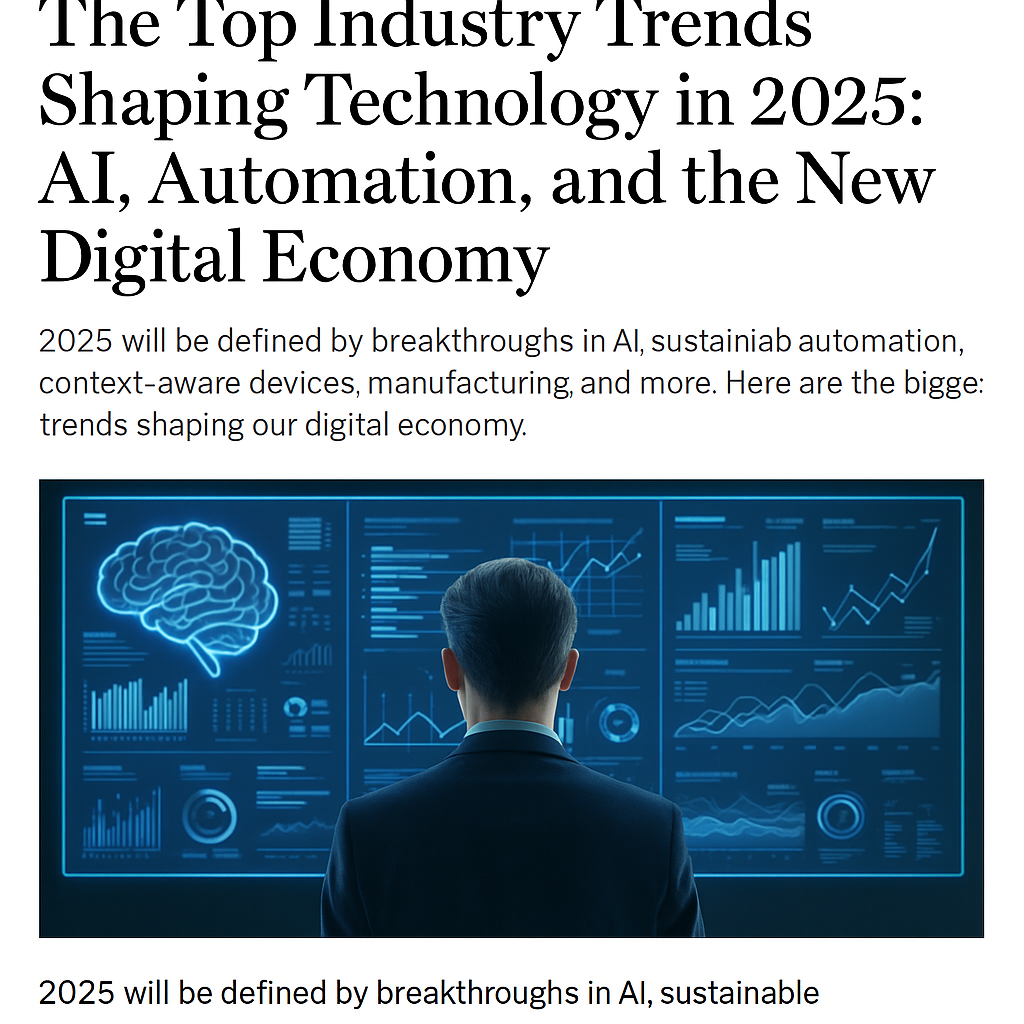
The global tech industry is entering its most disruptive era in decades.
With breakthroughs in AI acceleration, autonomous systems, sustainable hardware, and enterprise automation, the way companies build products, operate their workforce, and engage customers is being completely redefined.
Here are the major industry-transforming trends of 2025 that every business, innovator, and consumer should understand.
1. AI Acceleration Is Now the Core of Every Industry
AI is no longer a single tool — it’s the foundation of modern business.
Companies across all sectors now use:
- on-device AI chips
- enterprise-grade AI copilots
- automated content creation
- AI-driven customer support
- predictive analytics for supply chains
- AI-assisted engineering and coding
2025 marks the first year where AI becomes the default layer of work, manufacturing, logistics, and communication.
2. Automation Is Expanding Beyond the Factory Floor
Automation used to be reserved for manufacturing — but not anymore.
In 2025, automation has spread to:
- retail
- healthcare
- hospitality
- finance
- government services
- education
- logistics
Examples include:
- robot-assisted surgeries
- autonomous store checkout
- automated bookkeeping
- AI classroom assistants
- drone delivery systems
Automation is reshaping industries by increasing efficiency and reducing repetitive workloads.
3. Smart Hardware Is Becoming Context-Aware
Devices don’t just “respond” anymore — they adapt.
Context-aware devices now:
- adjust brightness based on mood
- predict user actions
- switch modes automatically
- detect health changes
- understand environmental patterns
2025 devices learn from behavior, creating a more intuitive digital ecosystem.
4. Sustainable Tech Manufacturing Is Rising Globally
Regulations and consumer demand have pushed industries toward sustainability.
Trends include:
- carbon-neutral factories
- recycled materials
- modular and repairable devices
- energy-efficient chip designs
- eco-focused packaging
Tech companies with strong sustainability programs are gaining significant competitive advantage.
5. Enterprise Cloud + On-Device AI Hybrid Systems Are the New Standard
Businesses are moving away from cloud-only systems.
Instead, 2025 sees a blend of:
- cloud computing for big workloads
- edge AI for privacy and speed
- local processing for sensitive data
This hybrid architecture improves:
- performance
- security
- latency
- operational cost
Key industries adopting this model include finance, healthcare, and automotive.
6. Hyper-Personalized Customer Experiences Are Reshaping Marketing
AI now enables companies to create:
- individualized recommendations
- dynamic pricing
- contextual promotions
- behavior-based content
- AI voice agents for support
Customer experience is becoming ultra-targeted, improving conversion rates and retention.
7. Spatial Computing Is Quietly Becoming a Major Industry Driver
While not yet fully mainstream, spatial computing is growing fast behind the scenes.
Industries using spatial tools:
- manufacturing (AR-guided assembly)
- medicine (AR surgery overlays)
- automotive (HUD navigation)
- education (immersive training)
- corporate teams (mixed reality collaboration)
Spatial computing is becoming one of the most strategically important emerging technologies.
8. Robotics Are Entering Homes and Businesses at Scale
2025 robots are smarter, cheaper, and more flexible.
Use cases include:
- household cleaning
- warehouse movement
- food preparation
- elderly care support
- autonomous security patrols
- retail stocking
Robotics is no longer future tech — it’s mass-market.
9. Chip Innovation Is Accelerating Every Sector
The 2025 chip race is driven by:
- ultra-efficient AI NPUs
- next-gen ARM architectures
- 3D chip stacking
- reduced thermal output
- more powerful integrated GPUs
These improvements power everything: phones, cars, factories, satellites, healthcare devices, and enterprise servers.
10. The Workforce Is Changing: AI-Augmented Jobs Become Normal
AI isn’t replacing humans — it’s augmenting how they work.
Employees now use:
- AI assistants
- real-time meeting summaries
- AI research tools
- automated workflow builders
- dynamic scheduling systems
The 2025 workplace is a blend of human creativity + machine efficiency.
The Bottom Line
2025 is a defining year for global industries.
AI acceleration, automation, hybrid cloud models, smart devices, sustainability, robotics, and spatial computing are reshaping how businesses operate — and how consumers experience technology.
Companies that embrace these trends will lead the next decade of innovation.
Leave a Reply