

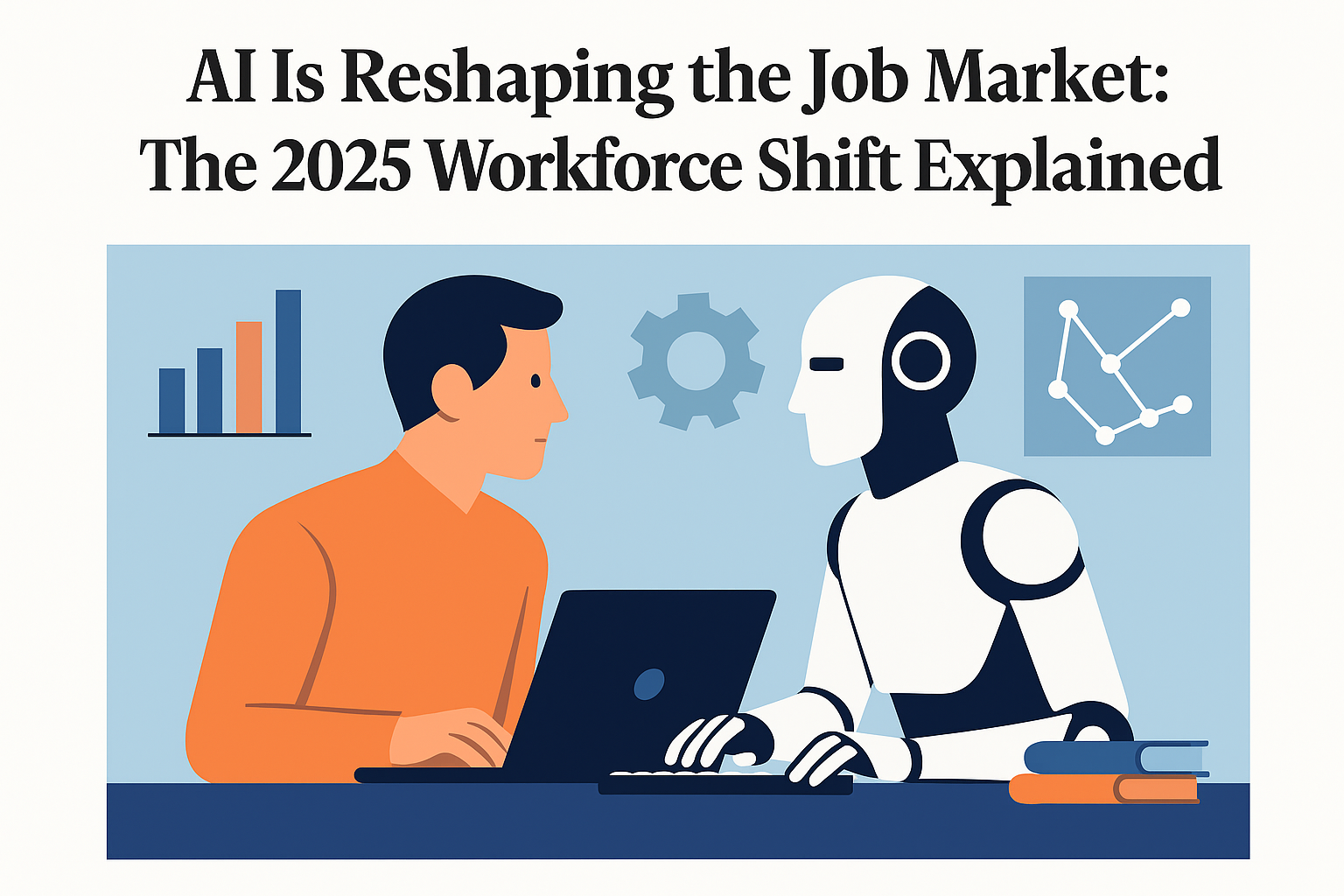
The global job market is undergoing its largest structural shift since the Industrial Revolution — driven almost entirely by artificial intelligence. As businesses adopt automated workflows and intelligent agents at scale, millions of jobs are evolving, disappearing, or being redefined.
The transition is happening faster than economists expected. A 2025 global labor report shows that 42% of companies have already replaced or redesigned roles using AI technologies, while 68% plan to accelerate automation over the next two years.
This shift is reshaping everything from corporate hiring to freelance work, demanding a new blend of skills and digital adaptability.
Routine Jobs Are Declining Across Multiple Sectors
Roles reliant on repetitive or predictable tasks are seeing the most disruption:
Jobs facing the highest decline:
- data entry clerks
- administrative assistants
- basic customer support agents
- payroll processors
- scheduling coordinators
- retail cashiers
- warehouse pickers
AI systems and automation tools can now complete many of these tasks faster, cheaper, and with fewer errors.
Hybrid Roles Are Emerging Everywhere
Contrary to early fears, AI is not replacing most workers — it’s augmenting them.
New hybrid roles combine human judgment with machine intelligence:
- AI Workflow Supervisor
- Automation Strategist
- Content Quality Controller
- AI-Assisted Research Analyst
- Prompt Engineering Specialist
- Digital Operations Manager
- Human-AI Interaction Designer
These positions didn’t exist five years ago but are now among the fastest-growing categories.
High-Skill Professions Are Being Transformed, Not Replaced
AI is reshaping — not eliminating — specialized careers.
Healthcare
Doctors use AI for diagnostic support, medical imaging, and patient record management.
Law
Lawyers rely on AI for case research, document drafting, and evidence analysis.
Finance
Analysts use AI for forecasting, fraud detection, and portfolio modeling.
Engineering
AI accelerates simulations, prototyping, and error detection.
Experts across these fields who adopt AI tools gain a significant productivity advantage.
AI Is Fueling a Freelance Boom
Freelancers are leveraging AI to produce more work with fewer resources:
- video creators using AI animation
- writers using drafting assistants
- designers using generative tools
- consultants using automated research agents
- coders using AI debugging and code generation
Freelancers who integrate AI into their workflow report 30–70% higher output.
The Skills Employers Want Most in 2025
A global hiring survey identifies these as the top in-demand skills:
1. AI Literacy
Ability to use AI tools and understand automation workflows.
2. Critical Thinking
Evaluating and refining AI-generated outputs.
3. Technical Adaptability
Comfort learning new software, tools, and digital interfaces.
4. Data Interpretation
Knowing how to read dashboards, analytics, and AI reports.
5. Creativity & Ideation
Human creativity remains irreplaceable across industries.
Employers now focus more on adaptability than formal degrees.
The Biggest Threat: The Skills Gap
Despite rapid AI adoption, nearly 60% of organizations report a widening gap between needed and available skills.
Workers who don’t update their digital capabilities risk being left behind.
Governments and companies are responding with:
- upskilling programs
- digital literacy training
- AI certification pathways
- university curriculum updates
But experts warn that the gap is still growing faster than education systems can adapt.
A New Era of Work Has Already Begun
AI is not eliminating work — it is changing what work looks like.
The winners of this new economy will be:
- workers who learn to collaborate with AI
- businesses that adopt automation early
- industries that embrace hybrid human-AI workflows
- nations that invest in digital education and infrastructure
The transformation is inevitable — but with the right skills, the opportunities are greater than ever.
Leave a Reply