

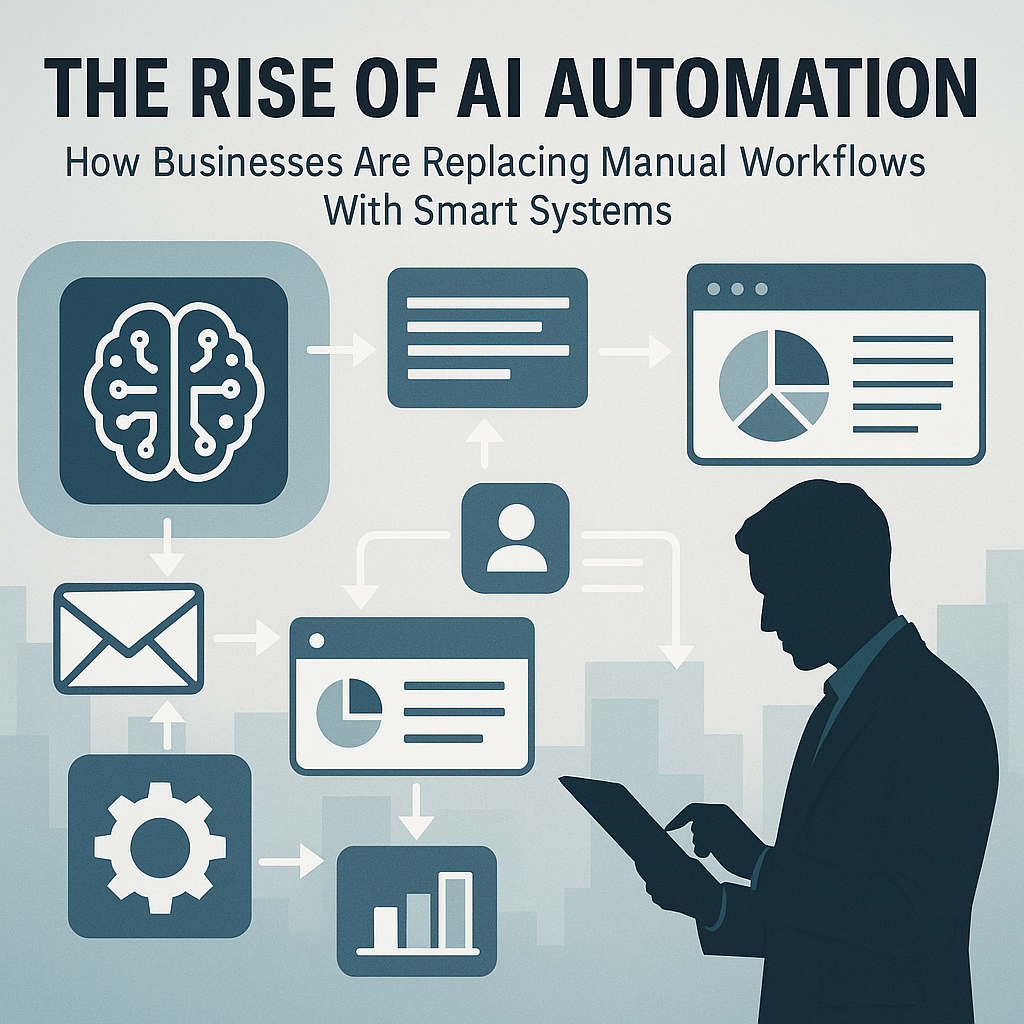
AI automation is rapidly becoming the backbone of modern businesses. From small startups to enterprise-level organizations, companies are increasingly turning to AI-powered workflow systems to replace repetitive manual tasks. The goal is simple: work faster, reduce costs, and eliminate human error — while allowing employees to focus on higher-value activities.
In 2025, adoption has accelerated to historic levels, with nearly every industry integrating automation tools into daily operations. What was once considered “future tech” is now a competitive necessity.
Why Businesses Are Rushing Toward Automation
Companies are adopting automation systems because they offer measurable advantages:
- Up to 60% reduction in manual processes
- Faster task completion
- Fewer operational errors
- Cost savings on labor-intensive work
- Better data accuracy and reporting
- Scalable workflows that grow with the business
Artificial intelligence turbocharges these benefits by enabling automation that thinks, adapts, and learns over time.
Popular Tools Leading the Automation Wave
Several platforms dominate the automation landscape due to their versatility and ease of use:
Zapier
Connects thousands of apps to automate everyday tasks.
Make.com
Ideal for complex visual workflows, multi-step logic, and enterprise automation.
OpenAI Assistants
Used to build smart agents that can read files, generate insights, classify content, and trigger automated actions.
Notion AI
Automates documentation, task management, and company knowledge bases.
Microsoft Power Automate
A favorite for corporate environments integrating cloud workflows into existing systems.
Each of these tools offers drag-and-drop functionality, making automation accessible even to non-technical professionals.
Real-World Applications You See Everywhere
AI automation is now embedded across multiple industries:
1. Customer Support
AI chatbots and support assistants handle:
- FAQs
- troubleshooting
- order tracking
- email responses
Companies reduce customer service loads by up to 70%.
2. Content Creation
AI tools automatically generate:
- product descriptions
- blog outlines
- social media posts
- reports and summaries
Marketing teams can maintain daily output with minimal human intervention.
3. Finance & Accounting
AI automates:
- invoice processing
- transaction categorization
- budget forecasting
- risk assessment
This increases accuracy and compliance.
4. HR & Recruiting
Software can now:
- screen applicants
- score resumes
- schedule interviews
- draft feedback reports
Automated systems eliminate hours of manual work per candidate.
AI Agents: The Next Frontier of Automation
The newest development in this space is AI agents — autonomous systems that can:
- break down tasks
- make decisions
- take action
- analyze data
- execute multi-step workflows
Unlike traditional automation, AI agents can adapt to changing data and conditions without explicit rules.
In business environments, agents are already being used for:
- automated research
- email management
- project coordination
- data monitoring
- task sequencing
This new technology marks a shift from rule-based automation toward true autonomous work processes.
Challenges and Risks Still Exist
While automation is powerful, it also introduces challenges:
- Over-automation can remove human oversight
- Poorly designed workflows may create system errors
- Teams need training to adapt
- Security concerns must be addressed
- Businesses must prevent overreliance on AI
Experts recommend combining automation with periodic human review to maintain accuracy and safety.
A More Efficient Future Is Already Here
As AI technologies mature, automation will only expand. By 2030, analysts predict that nearly half of all repetitive work across industries will be fully automated. Companies that adopt these systems early will gain a significant competitive edge — operating faster, smarter, and more efficiently.
AI automation is no longer optional.
It is becoming the foundation of modern business operations.
Leave a Reply