

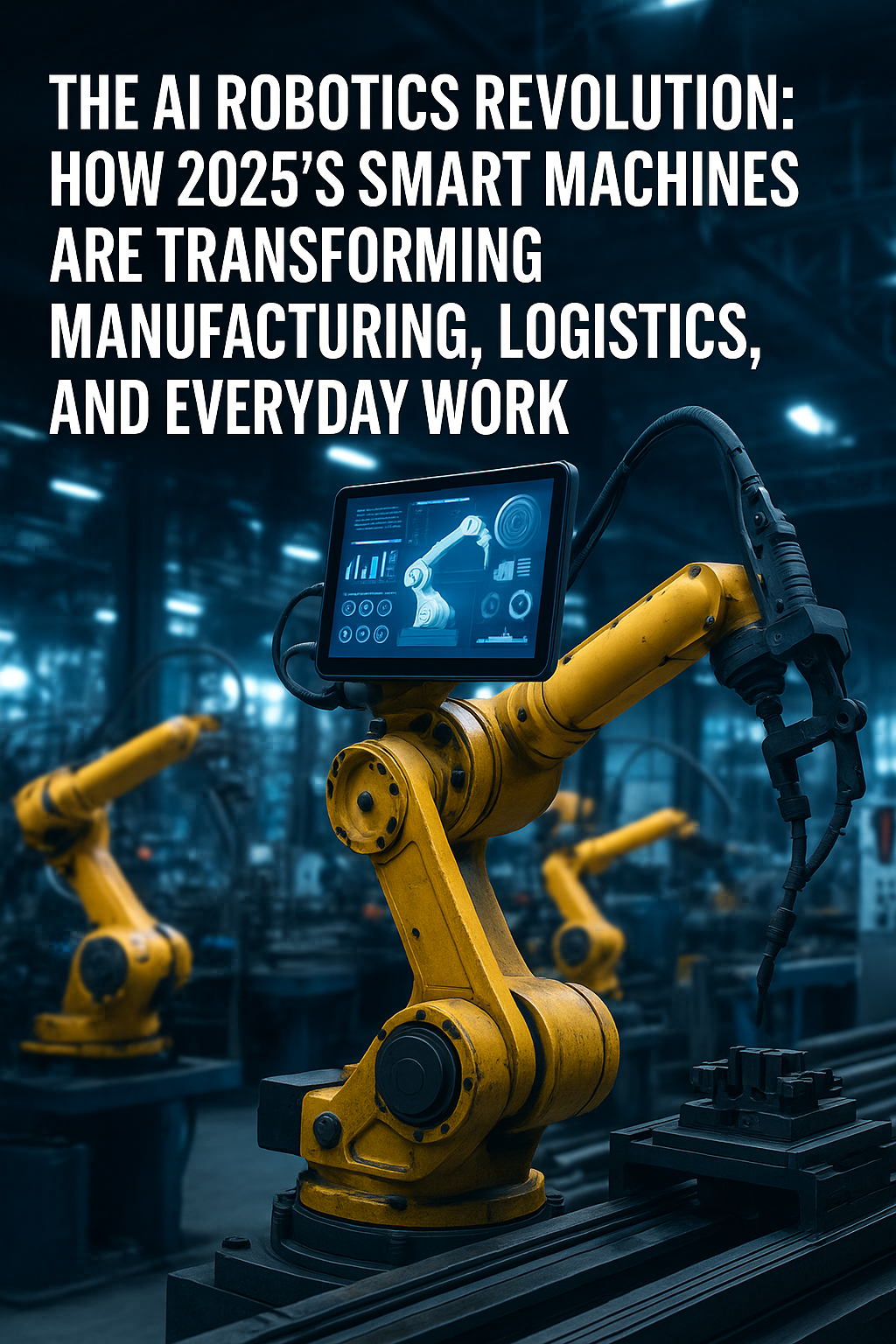
Robotics is entering its most transformative era yet.
In 2025, AI-powered robots are no longer confined to giant factories—they’re assisting in warehouses, hospitals, retail stores, restaurants, construction sites, and even small startups.
These “smart machines” combine advanced sensors, autonomous navigation, and generative AI reasoning to perform tasks that once required human-level judgment.
This is the robotics revolution defining 2025.
1. Manufacturing Robots Are Fully Autonomous
Factories now use AI-driven robots for:
- quality inspection
- precision assembly
- adaptive welding
- multi-step packaging
- automated defects correction
Robots adjust their workflows without human reprogramming, thanks to foundation AI models.
2. Logistics Robots Are Replacing Traditional Warehousing
Autonomous warehouse fleets handle:
- aisle navigation
- shelf scanning
- pallet loading
- order picking
- real-time inventory updates
Companies using robotics report 35–50% faster fulfillment.
3. Delivery Robots Are Becoming Mainstream
In 2025, delivery robots operate in:
- university campuses
- urban centers
- suburban neighborhoods
- industrial parks
They use AI mapping to avoid obstacles, identify safe paths, and coordinate with local infrastructure.
4. Service Robots Are Transforming Retail
Stores now use robots for:
- shelf stocking
- price tag updates
- customer assistance
- in-store delivery
- product recommendations
Retailers reduce labor costs while improving consistency.
5. Hospitals Are Deploying “Care Assistant” Robots
These robots can:
- deliver medication
- transport supplies
- assist nurses
- monitor patient vitals
- provide sanitation
Hospitals report fewer strain injuries among staff and faster supply routing.
6. Construction Robots Are Speeding Up On-Site Builds
2025 construction robots handle:
- bricklaying
- inspection
- autonomous surveying
- heavy lifting
- 3D-printed building frames
These machines reduce project timelines by up to 30%.
7. Restaurant and Kitchen Automation Is Surging
AI kitchen robots now:
- prep meals
- assist with cooking
- maintain food safety
- clean stations
- handle plating
Fast-food chains are leading adoption.
8. Small Startups Are Using Robots, Too
Affordable robotics kits give startups:
- automated packaging
- assembly assistance
- fulfillment support
- autonomous cleaning
- robotic receptionist systems
Robotics is no longer exclusive to giant companies.
9. Human-Robot Collaboration Is Becoming Seamless
AI models allow robots to:
- understand voice commands
- learn from demonstrations
- predict human movement
- work safely alongside employees
The boundary between human and machine teamwork is shrinking.
10. Robotics Is Now Driven by AI, Not Manual Programming
The biggest shift of 2025:
Robots no longer rely on rigid code—they use AI reasoning models to decide how to act.
This enables:
- complex multi-step planning
- real-time error correction
- adaptive problem-solving
- self-improving workflows
Robots are becoming “colleagues,” not just tools.
The Bottom Line
2025 marks the beginning of an era where robotics becomes universal.
From factories and hospitals to retail and small startups, AI-powered robots are enabling faster, safer, and more efficient operations across every major industry.
This is not the future of work — it is the present.
Leave a Reply