

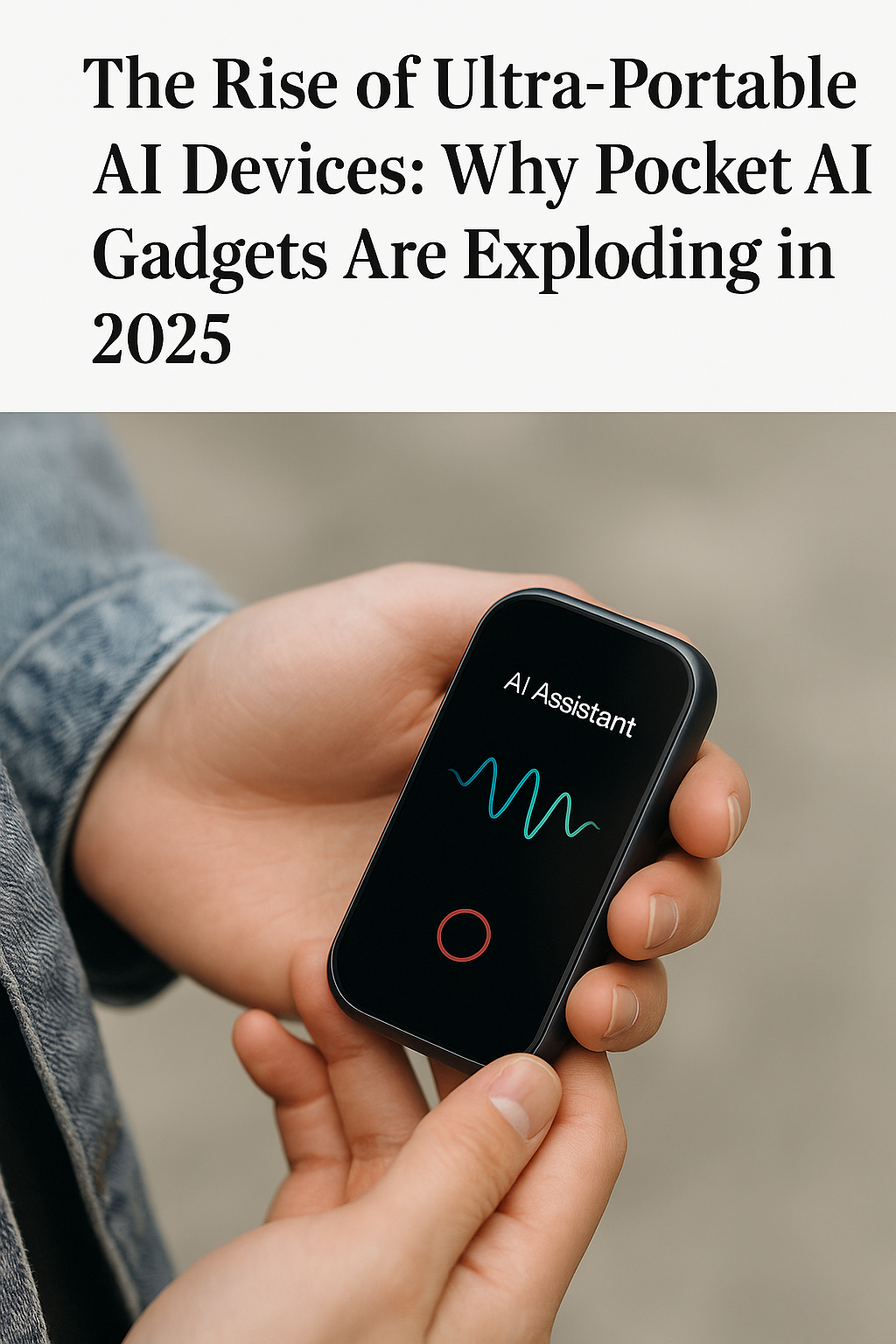
In 2025, a new class of hardware is redefining the idea of personal computing: ultra-portable AI devices. These pocket-sized assistants combine on-device intelligence, voice control, instant translation, and personalized automation in a form factor smaller than a smartphone.
Driven by advancements in edge AI chips and a growing demand for minimalistic tech, these compact devices are quickly becoming essential for students, professionals, travelers, and creators.
Small, Powerful, and Always Available
Unlike smartphones, which attempt to do everything, pocket AI devices are designed with a single purpose:
To assist you instantly — without distractions.
These devices typically include:
- high-efficiency Neural Processing Units (NPUs)
- offline AI speech models
- contextual task memory
- long battery life
- omnidirectional microphones
- compact OLED/LED displays
- gesture and touch controls
They are light enough to clip onto clothing or carry on a keychain.
Why Pocket AI Devices Are Becoming Popular
1. They Reduce Digital Distractions
These gadgets allow you to:
- take notes
- set reminders
- send messages
- record ideas
- get answers
- translate languages
without opening social apps, browsing feeds, or getting notifications that derail your focus.
2. Battery Life Is Exceptional
With small screens and efficient chips, these devices often last:
- 2–5 days on a single charge
- 30+ hours of continuous listening mode
making them ideal for travel and outdoor use.
3. On-Device AI Protects Privacy
Top models run AI models locally, meaning:
- no cloud connection required
- no sensitive data uploaded
- instant responses
- strong privacy for professionals and creators
This solves the biggest concern people have with smartphone-based assistants.
Key Features That Are Making Pocket AI Devices Take Off
Real-Time Translation
Instant spoken-language translation is a flagship feature in 2025.
These devices support:
- 30–70 languages
- conversational flow
- offline translation
- cultural tone adjustments
Great for travelers, international students, and remote teams.
Voice-Controlled Productivity
Instead of typing, users issue commands like:
- “summarize this meeting note”
- “schedule my appointment for Friday at 3”
- “remind me to send the proposal”
- “start transcription mode”
AI handles tasks instantly.
Transcription & Note-Taking
Writers, journalists, and students rely on:
- real-time audio transcription
- instant summaries
- keyword tagging
- searchable offline notes
Meeting notes and ideas become organized automatically.
Context-Aware Assistance
Using sensors and historical data, the device understands context:
- at the office → work mode
- at home → personal mode
- in transit → travel mode
- in a meeting → silent + transcription mode
This makes the assistant feel intuitive and human-like.
Who Is Using Pocket AI Devices in 2025?
Students
For lectures, research, reminders, studying, and organization.
Professionals
For meetings, voice notes, productivity workflows, and travel.
Travelers
For translation, navigation, and language support.
Creators & Journalists
For voice memos, idea capture, and instant transcription.
Remote Workers
For quick tasks without opening a laptop or phone.
Leading Pocket AI Devices of 2025
- OpenAI Pocket Assistant
- Google Micro-Assistant
- Apple AI Clip (rumored release Q4 2025)
- Rewind Pendant
- AURA Palm AI
- OnePlus Pocket AI
Each focuses on privacy, offline capability, and long battery performance.
The Future: Your “Second Brain” in Your Pocket
Over the next few years, pocket AI gadgets will evolve into:
- ultra-fast offline AI models
- miniature projectors for displays
- augmented reality voice navigation
- holographic notifications
- biometric health integration
- personal memory systems
The idea of carrying a “second brain” — a personal assistant that understands your habits, preferences, and tasks — is becoming a reality.
The Bottom Line
Ultra-portable AI devices are the next big wave of consumer technology.
Smarter than wearables and more focused than smartphones, they’re creating a new ecosystem of personal assistance that fits in the palm of your hand.
2025 is the year pocket AI becomes indispensable.
Leave a Reply