

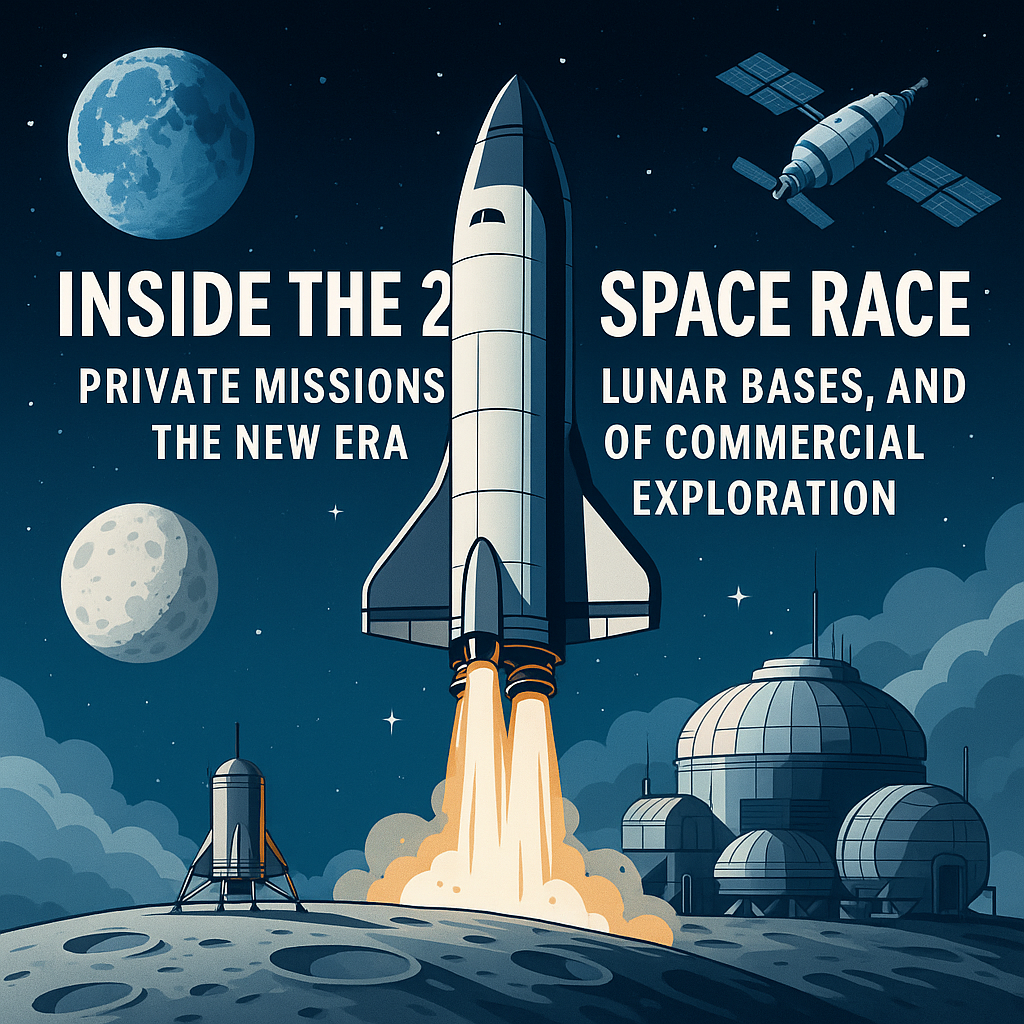
Space exploration in 2025 looks nothing like the government-driven missions of previous decades.
Thanks to private aerospace companies, AI-powered spacecraft, and international collaboration, humanity is entering a new era where commercial space programs push innovation forward faster than ever before.
Here are the biggest developments defining the new space race.
1. Private Companies Are Dominating Orbital Launches
For the first time, over 70% of global orbital launches in 2025 come from private companies.
These firms are leading in:
- reusable launch vehicles
- rapid turnaround missions
- micro-satellite delivery
- commercial cargo transport
- low-orbit tourism programs
Lower launch costs are accelerating space access for research and industry.
2. Lunar Base Construction Has Officially Begun
Multiple agencies have started deployment of:
- lunar power stations
- autonomous construction robots
- 3D-printed shelter foundations
- permanent communication hubs
The first semi-permanent lunar base is expected by 2028, marking a massive milestone for long-term exploration.
3. AI-Powered Spacecraft Are Reducing Mission Risk
AI systems now manage:
- navigation
- hazard detection
- thermal balancing
- resource management
- mission-time decision making
Autonomous systems allow spacecraft to respond instantly to unexpected conditions without waiting for Earth commands.
4. Reusable Rockets Are More Efficient Than Ever
Next-generation reusable boosters provide:
- reduced turnaround from days to hours
- lower material fatigue
- automated landing accuracy
- decreased mission costs
2025 rockets are now more reliable than many legacy single-use vehicles.
5. Mars Sample Return Missions Reach New Milestones
This year’s breakthroughs include:
- the first sealed Martian soil transfer to Earth-orbit
- autonomous sterilization modules
- contamination-free transport tanks
A full return mission is expected early in the 2030s.
6. Space Telescopes Are Entering a New Era of Resolution
The latest telescopes launched this year feature:
- AI-corrected lens alignment
- ultra-deep field imaging
- exoplanet atmospheric sampling
- dark matter mapping tools
Astronomers are observing cosmic structures that were previously invisible.
7. Commercial Space Stations Are Expanding Rapidly
After the ISS retirement plan, private companies are building stations designed for:
- research
- tourism
- manufacturing
- satellite servicing
These next-generation stations will operate with hybrid public-private partnerships.
8. Asteroid Mining Tech Is Progressing Faster Than Expected
Several missions are currently testing:
- robotic material extraction
- ore heat-processing pods
- sample return systems
- in-space refinement units
While commercial mining is still years away, 2025’s progress is promising.
9. Space Tourism Is Becoming (Slightly) More Accessible
More companies now offer:
- 90-minute Earth-orbit rides
- extended stay orbital hotels (late-2025 testing)
- AI-guided observation decks
- multi-day zero-gravity experiences
Prices are still high, but dropping steadily.
10. Nations Are Establishing New “Space Traffic Laws”
With thousands of satellites in low-Earth orbit, governments are implementing:
- debris avoidance rules
- mandatory satellite tracking
- AI-based collision warning systems
- de-orbit requirements
Space is becoming organized, monitored, and safer for long-term use.
The Bottom Line
2025 marks the beginning of a new space era — one driven by private innovation, powerful AI, and ambitious international projects.
Humanity’s return to the Moon, exploration of Mars, and expansion into commercial orbital infrastructure signal a future where space is no longer distant, but deeply integrated into global industry.
Leave a Reply