

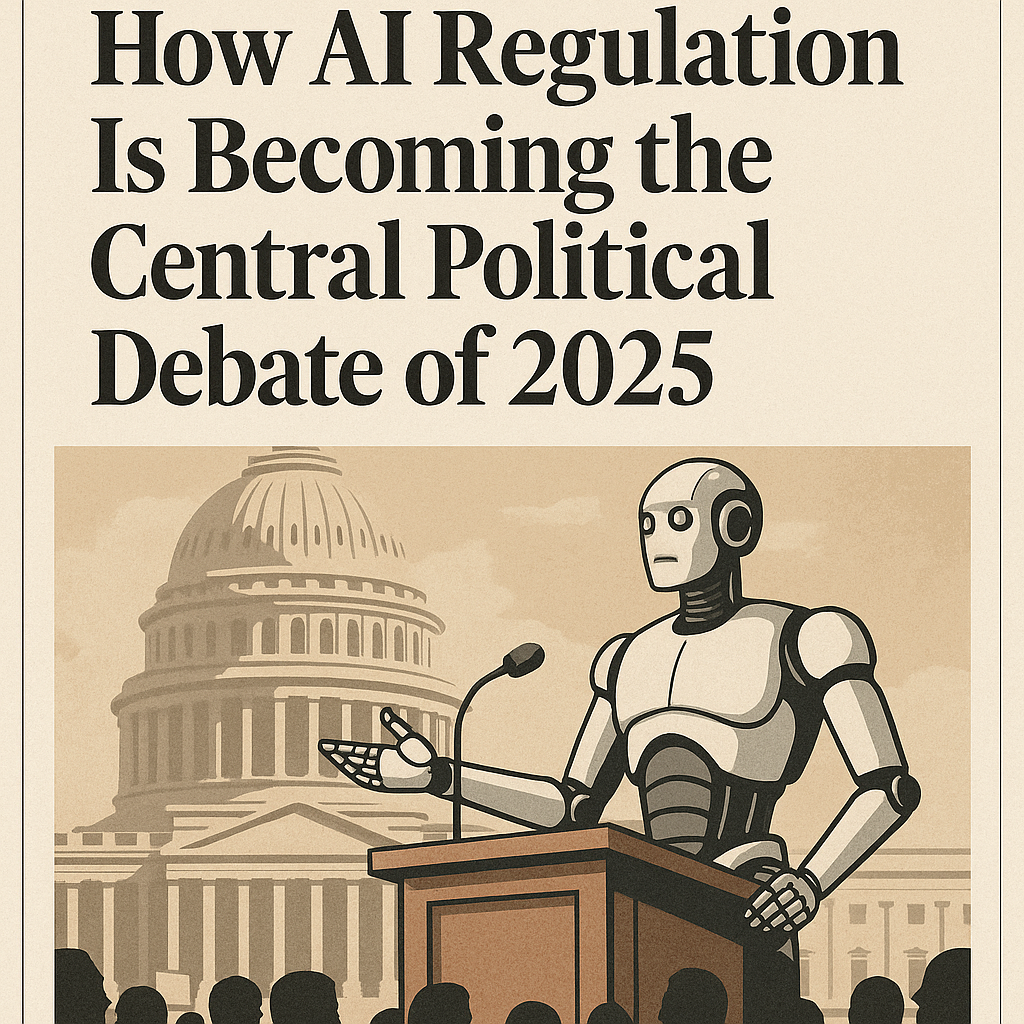
Artificial intelligence is progressing faster than any technology in modern history — and governments around the world are racing to keep up.
In 2025, AI regulation has become one of the most important and politically charged issues, shaping debates in national elections, policy committees, and global alliances.
Here’s how AI policy is influencing politics this year — and why it matters for the future.
1. Governments Are Creating New AI Safety Agencies
Countries are establishing dedicated agencies responsible for:
- auditing high-risk AI systems
- certifying enterprise AI tools
- monitoring deepfake content
- enforcing safety protocols
- overseeing AI in healthcare, finance, and defense
These agencies act as regulators in the same way food, drugs, and transportation systems are governed.
2. Deepfake Legislation Is Expanding Rapidly
With political deepfakes increasing, new laws require:
- content watermarking
- identity verification for political ads
- criminal penalties for harmful deepfakes
- mandatory transparency labels
- platform responsibility in rapid removal
Some nations even require AI-generated media to include embedded signatures.
3. Data Privacy Is Becoming the Centerpiece of AI Policy
The public is demanding clearer rules around:
- how AI systems use personal data
- whether training data should be disclosed
- how long companies can store user information
- who gets access to AI-generated profiles
- opt-out rights for data processing
Policies are now shifting toward user-first transparency.
4. Countries Are Dividing Into “Open AI” and “Restricted AI” Blocks
Nations are forming strategic alliances around AI policy.
Two dominant models:
Open AI Model
- supports open-source AI
- encourages innovation
- promotes international AI collaboration
- less restrictive but monitored
Restricted AI Model
- prioritizes safety and strong regulation
- places limits on model abilities
- restricts data-sharing
- emphasizes national control
This deepening divide is shaping global tech diplomacy.
5. Ethical AI in Healthcare Is a Major Debate Topic
Governments are debating how far AI should go in:
- diagnosis
- treatment recommendations
- patient data analysis
- predictive health analytics
Laws are emerging to prevent discrimination while enabling medical innovation.
6. Political Campaigns Are Facing Stricter AI Rules
AI is reshaping political communication, but governments are responding with:
- bans on AI-generated political personas
- restrictions on automated persuasion
- transparency requirements for AI-written messages
- limits on micro-targeting voters
Campaigns must adapt — or face penalties.
7. AI in Education Is Facing Public Scrutiny
As AI tools enter classrooms, policymakers are addressing:
- student data protection
- AI-assisted learning fairness
- cheating prevention
- teacher training for AI use
- oversight of academic integrity tools
Education is one of the biggest battlegrounds for ethical AI.
8. Public Opinion Is Shaping AI Lawmaking
Surveys show:
- 74% support clearer AI transparency
- 68% worry about job displacement
- 82% demand restrictions on deepfakes
- 59% believe AI will help the economy
- 61% want limits on autonomous weapons
Voters are influencing every political decision surrounding AI.
9. Tech Companies Are Lobbying Heavily
Major corporations are urging governments to:
- avoid overregulation
- encourage innovation
- standardize global rules
- support AI in business and research
- avoid fragmentation of tech markets
The battle between innovation and regulation is intensifying.
10. The Future of AI Regulation Will Shape the Next Decade
Experts predict the next 10 years will see:
- unified international AI laws
- standardized AI certification tiers
- regulated access to high-power models
- new digital rights for citizens
- cross-border AI safety agreements
AI policy created today will determine the future of global technology — and global democracy.
The Bottom Line
AI regulation in 2025 is not just a tech issue — it’s a political issue that affects national security, privacy, democracy, education, and economic growth.
What governments decide now will define how AI is used for generations.
Leave a Reply