

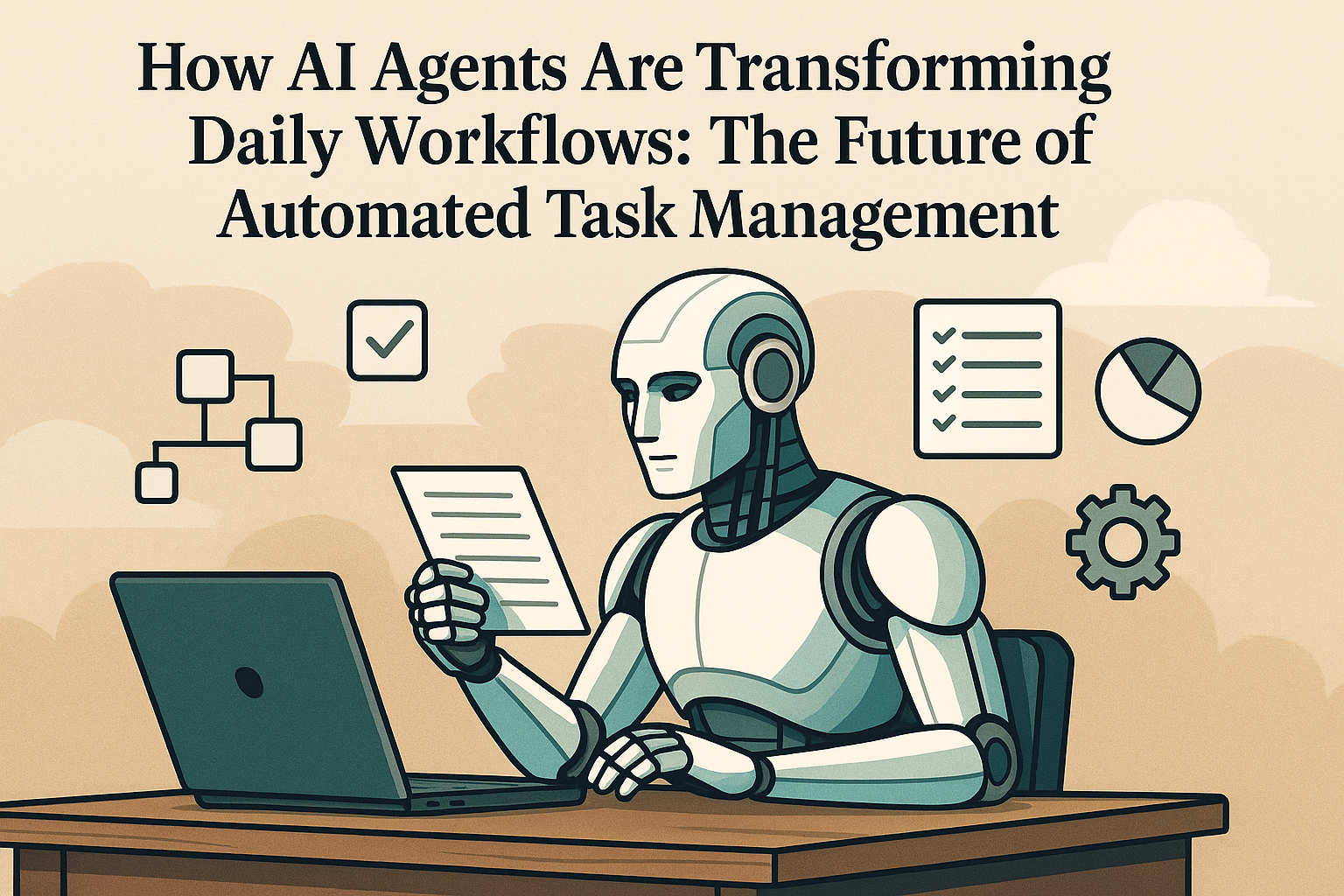
AI agents are emerging as one of the most impactful technological breakthroughs of the decade. Unlike traditional automation — which follows fixed rules — AI agents can reason, make decisions, take action, and execute multi-step tasks without constant human supervision.
This shift is redefining how businesses and professionals manage work, turning AI agents into digital assistants capable of operating like full-fledged team members.
What Exactly Are AI Agents?
AI agents combine:
- reasoning models
- natural language understanding
- API/tool access
- memory modules
- workflow planning
- self-correction mechanisms
This allows them to:
- break down tasks into logical steps
- decide the best sequence of actions
- analyze data
- revise and improve outputs
- complete tasks autonomously
They represent a major advancement compared to simple automation scripts.
How AI Agents Are Being Used Today
AI agents are now embedded across diverse industries:
1. Research & Information Gathering
Agents can skim articles, summarize data, compare sources, and generate complete research reports.
2. Email & Communication Management
They can draft responses, categorize emails, schedule meetings, and follow up automatically.
3. Project Management
Agents create sub-tasks, adjust deadlines, reassign workload, and monitor project progress.
4. Data Monitoring & Analytics
They interpret dashboards, generate insights, track KPIs, and notify teams of anomalies.
5. Content Creation
Agents manage content pipelines, generate draft versions, distribute materials, and optimize SEO output.
In some businesses, a single AI agent handles the workload of multiple employees.
Why AI Agents Outperform Traditional Automation
Traditional automation:
✔ follows instructions
✘ cannot adapt or reason
✘ breaks when data changes
AI agents:
✔ analyze new conditions
✔ make decisions
✔ correct mistakes
✔ learn patterns
✔ apply logic to new situations
This makes them more reliable in dynamic environments.
AI Agents in the Workplace: Real Examples
Companies are witnessing transformative results:
- Law Firms: Agents analyze case files, prepare briefs, and generate structured summaries.
- Marketing Agencies: Agents handle campaign reports, content creation, and tracking analytics.
- Healthcare Providers: Agents manage scheduling, patient questionnaires, and documentation.
- E-commerce Brands: Agents monitor inventory, update product details, and manage customer inquiries.
These changes reduce operational costs and free employees to focus on strategy and innovation.
Challenges and Ethical Considerations
Despite their benefits, AI agents pose questions:
- How much autonomy should an AI be given?
- Which tasks are too sensitive to automate?
- How is accountability assigned?
- What protections should be in place for sensitive data?
Businesses must combine automation with governance to ensure safe deployment.
The Path Forward
AI agents represent a significant milestone in the evolution of automation. As their reasoning capabilities continue to improve, we will soon see agents managing entire workflows, operating departments, and collaborating with human teams in real time.
The future of work is not just automated — it is intelligent, adaptive, and agent-driven.
Leave a Reply