

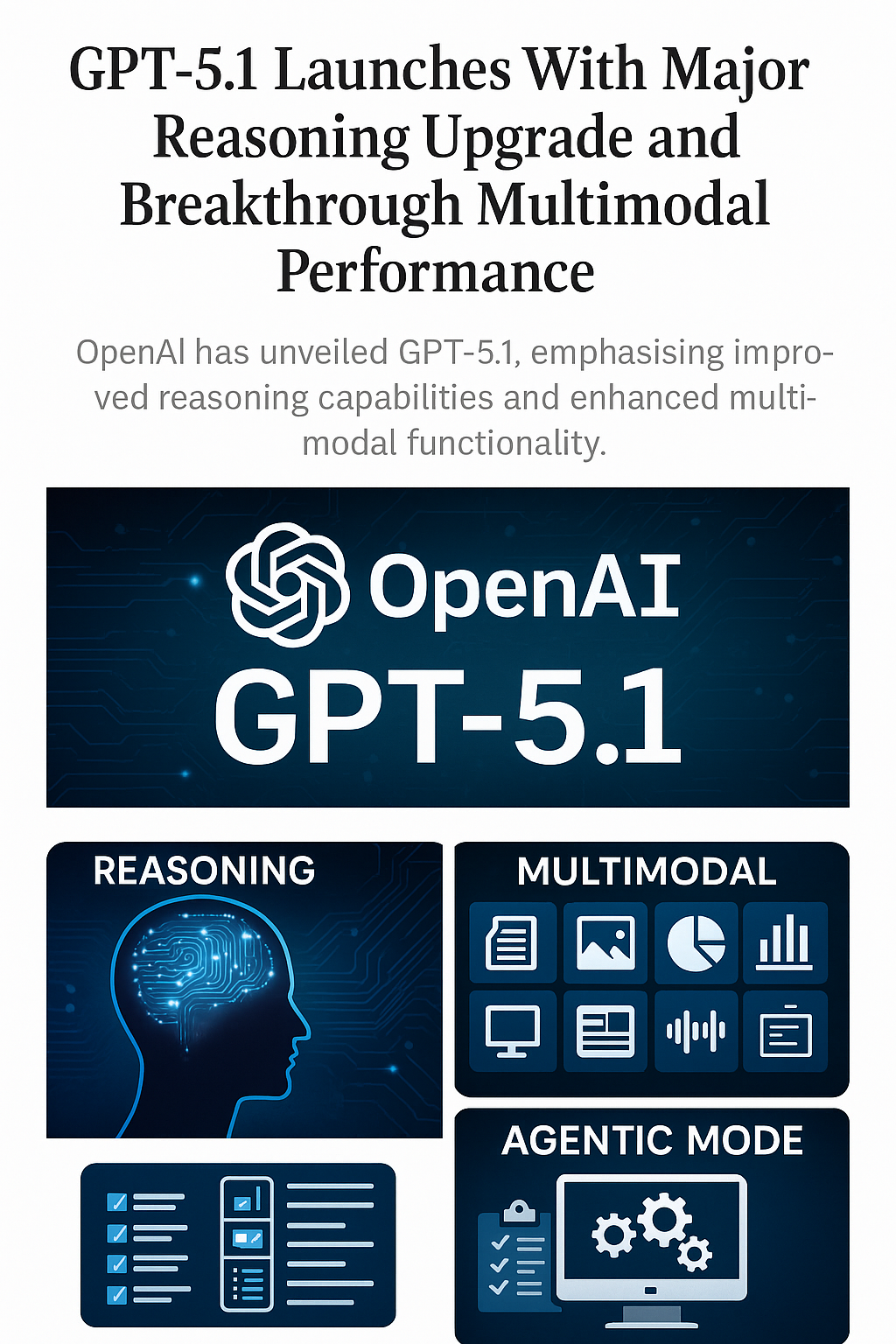
OpenAI has officially launched GPT-5.1, a major upgrade to its GPT-5 architecture and one of the most advanced AI systems available to the public. The new version introduces dramatic improvements in reasoning, memory, multimodal processing, and agentic behavior — positioning it as a powerful tool for developers, businesses, researchers, and creators.
GPT-5.1 is already being integrated into AI platforms globally, with early testers reporting significant gains in factual accuracy, deeper contextual understanding, and drastically reduced hallucinations.
A Major Leap in Reasoning Ability
One of the most significant improvements in GPT-5.1 is its reasoning engine. OpenAI redesigned sections of the transformer architecture to improve how the model handles:
- multi-step logic
- long-form problem solving
- numerical reasoning
- ambiguous or incomplete prompts
- real-world task planning
Early benchmarks show a 24–40% improvement in complex reasoning tasks compared to GPT-5.0.
According to OpenAI, GPT-5.1 also uses a new error-checking layer that helps the model evaluate its own output for potential inaccuracies before responding — an early step toward self-verification.
Breakthrough Multimodal Performance
GPT-5.1 continues OpenAI’s push into multimodal AI by dramatically improving processing of:
- images
- documents
- charts
- screenshots
- web pages
- audio transcriptions
The model shows better object recognition, faster image-to-text conversion, improved layout understanding, and enhanced visual reasoning.
For businesses, this means GPT-5.1 can now:
- summarize documents from photos
- interpret graphs and charts with higher precision
- read menus, signs, forms
- analyze UX/UI screenshots
- extract data from invoices or receipts
This opens new real-world use cases for industries like finance, healthcare, logistics, customer support, and education.
Fewer Hallucinations and Higher Accuracy
OpenAI claims GPT-5.1 is trained using a more rigorous reinforcement learning process, resulting in:
- improved factual consistency
- reduced hallucination rate
- better source reasoning
- more stable long-form responses
In academic testing, GPT-5.1 outperformed GPT-4.1 and GPT-5.0 in:
- math reasoning
- coding accuracy
- scientific responses
- legal comprehension
- historical context reliability
This aligns with OpenAI’s broader mission to create more trustworthy AI systems.
Smarter Agents and Autonomous Workflow Capabilities
GPT-5.1 introduces a new “Agentic Mode,” allowing the AI to:
- break tasks into steps
- perform multi-stage workflows
- execute sequences without repeated prompting
- correct its own mistakes
- call external tools or APIs
This agent-like behavior enables GPT-5.1 to complete tasks such as:
- planning events
- generating content pipelines
- analyzing spreadsheets
- researching topics
- creating workflows or automation scripts
Developers can now integrate GPT-5.1 as a semi-autonomous worker in production systems.
Real-World Use Cases Expanding Rapidly
Early adopters are already using GPT-5.1 for:
- AI customer service
- automated research
- business reporting
- financial analysis
- UI/UX testing
- automated news writing
- code debugging
- medical documentation support
Companies report that the improved speed and accuracy allow them to replace older AI pipelines entirely.
What Comes Next?
OpenAI says GPT-5.1 is part of a new rapid-iteration cycle, meaning future updates — GPT-5.2, GPT-5.3, etc. — will roll out more frequently.
The launch also hints at a slow transition toward GPT-6, expected to feature significantly improved autonomy and possibly real-time learning.
For now, GPT-5.1 is the most powerful publicly available model and sets a new standard for the industry.
Leave a Reply