

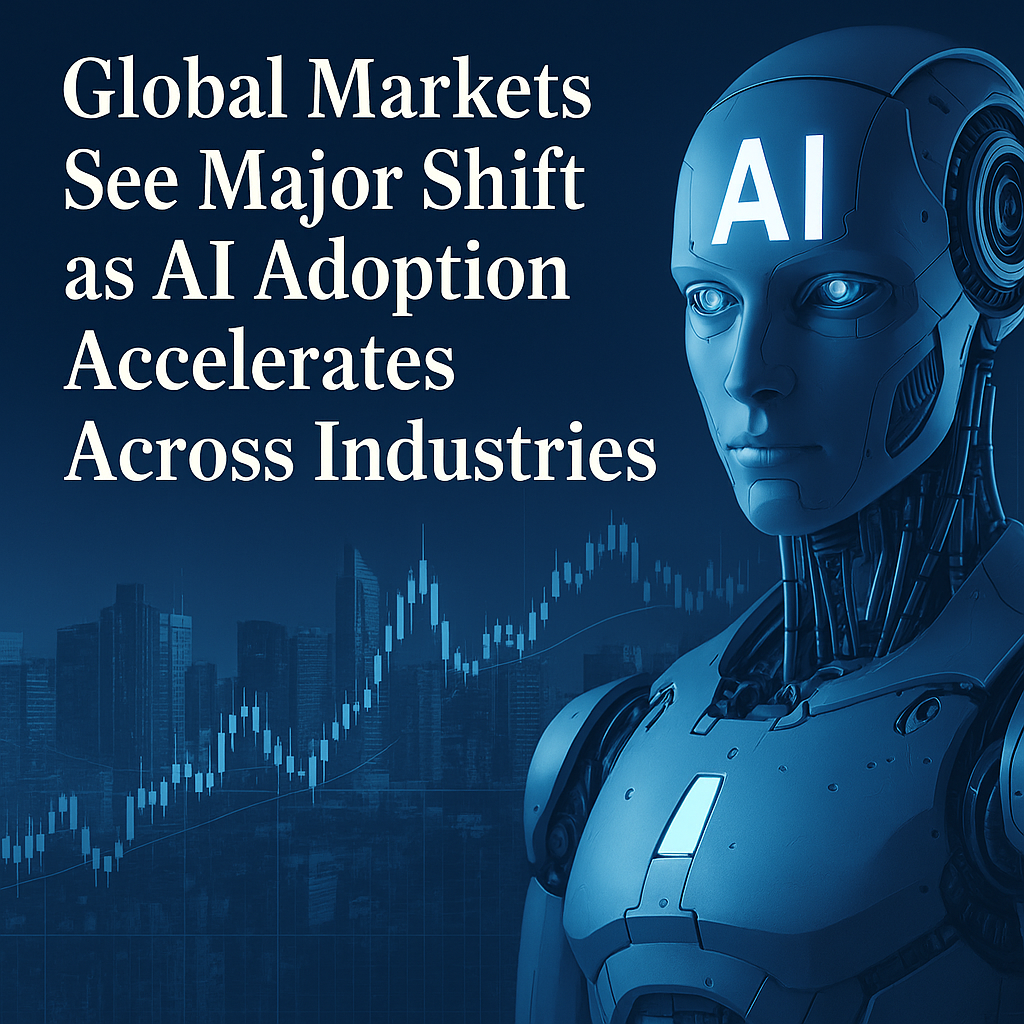
The global economy is undergoing one of the fastest structural transformations in decades as artificial intelligence becomes deeply embedded in nearly every major industry. From manufacturing and finance to healthcare and logistics, the integration of AI systems is shifting productivity, labor dynamics, and overall market growth.
Economists now predict that AI could contribute up to $4.4 trillion annually to global GDP by the early 2030s — a figure comparable to adding a new economic superpower to the global system.
AI Is Driving a New Productivity Wave
Across industries, AI tools are enabling companies to:
- automate repetitive tasks
- process financial and operational data instantly
- reduce overhead costs
- improve output accuracy
- scale operations with fewer constraints
Businesses using AI report 10–30% productivity gains in the first year alone.
Labor Markets Are Experiencing Rapid Change
The rise of AI-powered automation is transforming the workforce in three key ways:
1. Demand for Technical Roles Is Surging
Skills like machine learning engineering, data science, and automation design are now essential.
2. Administrative and Routine Roles Are Declining
AI systems handle tasks like scheduling, data entry, customer support, and reporting.
3. New Hybrid Jobs Are Emerging
Roles that combine human creativity + machine intelligence — such as AI supervisors, automation strategists, and prompt engineers — are becoming commonplace.
Economists emphasize that the shift mirrors past technological revolutions: jobs evolve, but they do not disappear entirely.
AI-Driven Industries Are Outperforming the Market
Sectors integrating AI early are seeing significant growth:
Technology
AI-generated software, automation platforms, and agent-based systems lead revenue increases.
Healthcare
AI is used for diagnostics, patient record analysis, and reducing administrative workloads.
Finance
Banks and fintech companies rely on AI for fraud detection, forecasting, and real-time market analysis.
Manufacturing
Predictive maintenance, robotics, and workflow automation are boosting efficiency.
Retail & E-Commerce
AI helps optimize logistics, personalize shopping, and manage inventory more effectively.
These industries are expected to outpace global GDP growth for the next decade.
Small Businesses Are Benefiting the Most
AI is not just for large enterprises. Small businesses now use AI tools to:
- manage accounting
- automate marketing
- analyze sales
- handle customer support
- optimize supply chains
With low-cost automation tools available, small companies are experiencing levelled competition against major corporations.
The Rise of AI Regulation and Safety Standards
As AI permeates global markets, governments are implementing new policies addressing:
- transparency in AI decision-making
- data privacy
- model safety
- workforce protection
- ethical use guidelines
The EU AI Act and U.S. AI Framework are expected to influence global standards.
Economic Power Is Beginning to Shift
Countries leading in AI innovation — including the U.S., China, South Korea, the UK, and several EU nations — are gaining competitive advantages.
Meanwhile, emerging economies adopting AI early are experiencing faster digital transformation.
Analysts predict that AI leadership may define economic power in the next 20 years, similar to how industrialization shaped the 20th century.
The Future of the AI-Driven Economy
AI will continue to reshape productivity, labor markets, and global competition. Experts agree that the world is at the beginning of a long-term economic transformation driven by automation, intelligent systems, and rapid technological evolution.
The next decade will define which industries — and which nations — adapt successfully to the AI economy.
Leave a Reply